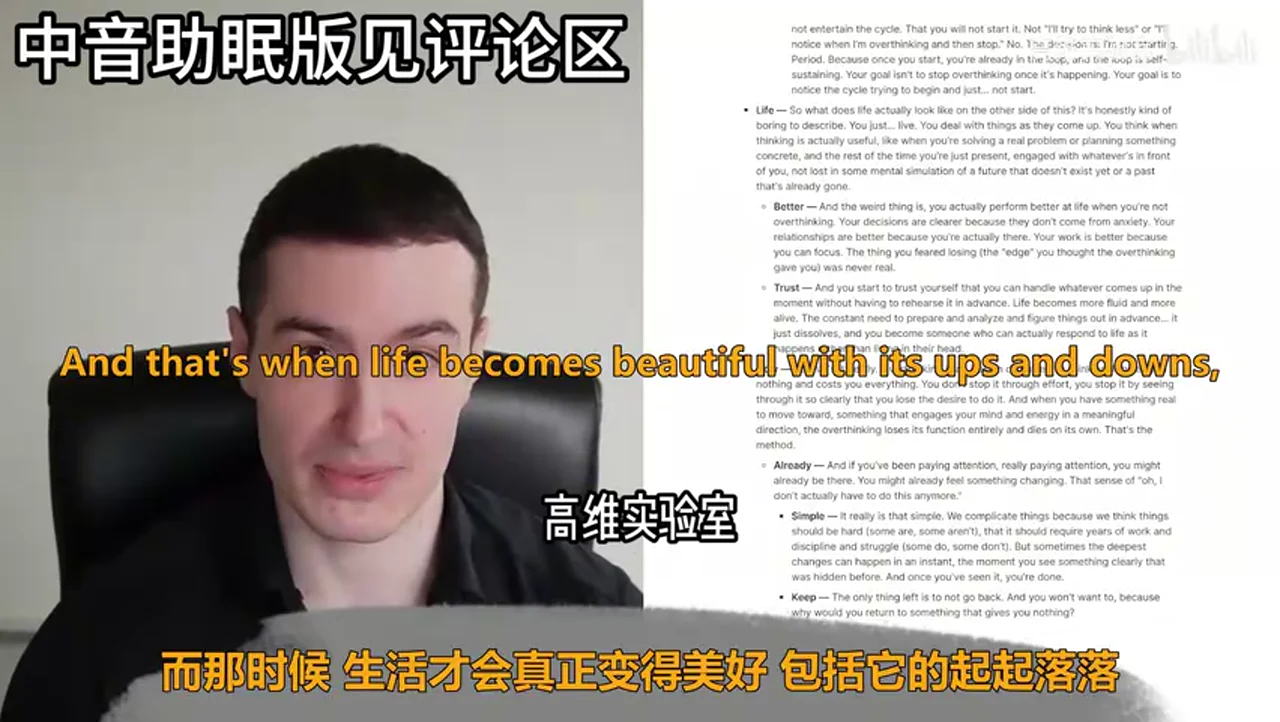
总结
视频定位
这是一段把“过度思考”解释为反复、无方向的心理循环的自助型分享。讲者的核心叙事是:人因不确定感而反复分析;分析带来片刻“我正在处理”的感觉,却没有改变现实,于是又回到更强的不安。视频建议先识别这个循环、不过度压制念头、把注意力转回当下可做的事与具体方向。
这个叙事可以帮助读者区分“为一个明确决策搜集信息”与“围绕同一担忧反复推演”,但它不是心理健康评估,也不构成治疗建议。视频中关于成瘾、戒断、治疗和“永久解决”的说法存在重要的证据边界,不能照单全收。
内容脉络
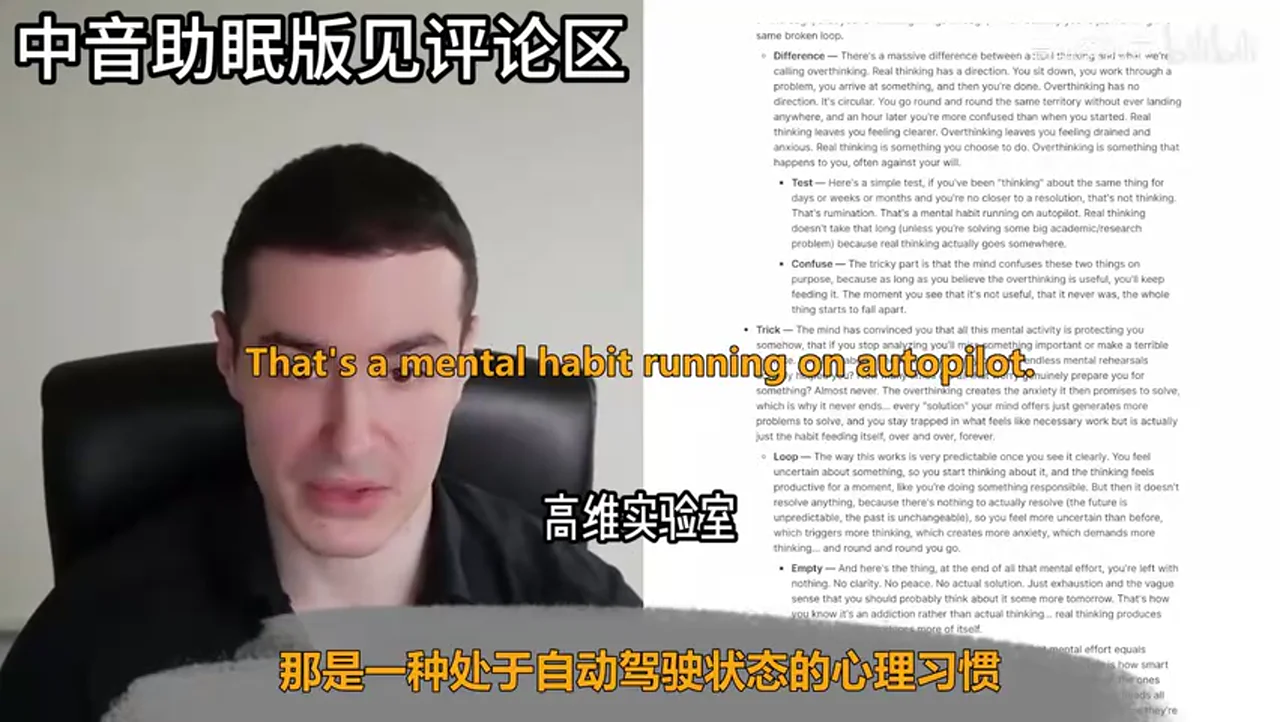
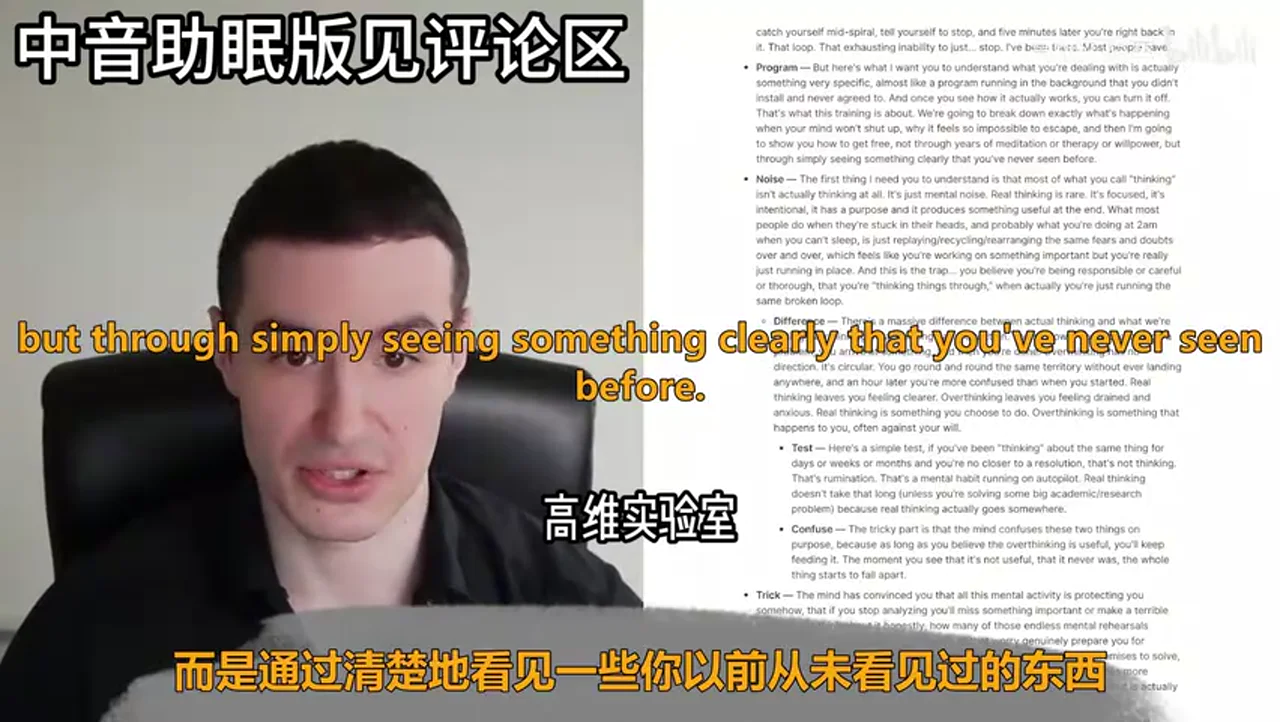
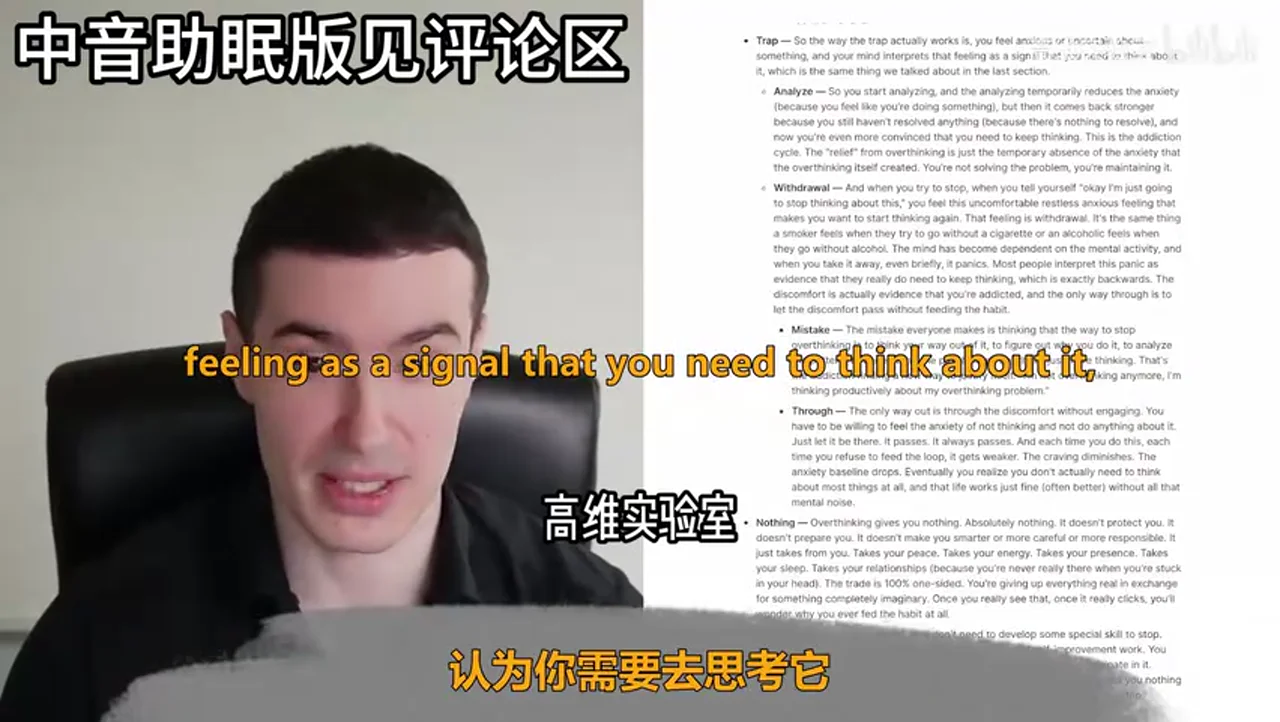
- 区分解决问题与循环推演。 讲者把前者描述为有对象、能得出下一步或结论的思考;把后者描述为反复回放过去、模拟未来、越想越累却没有新增行动的信息循环。下图只呈现视频把它称为“自动驾驶的心理习惯”的主张;它不证明任何观众的体验属于某种诊断。
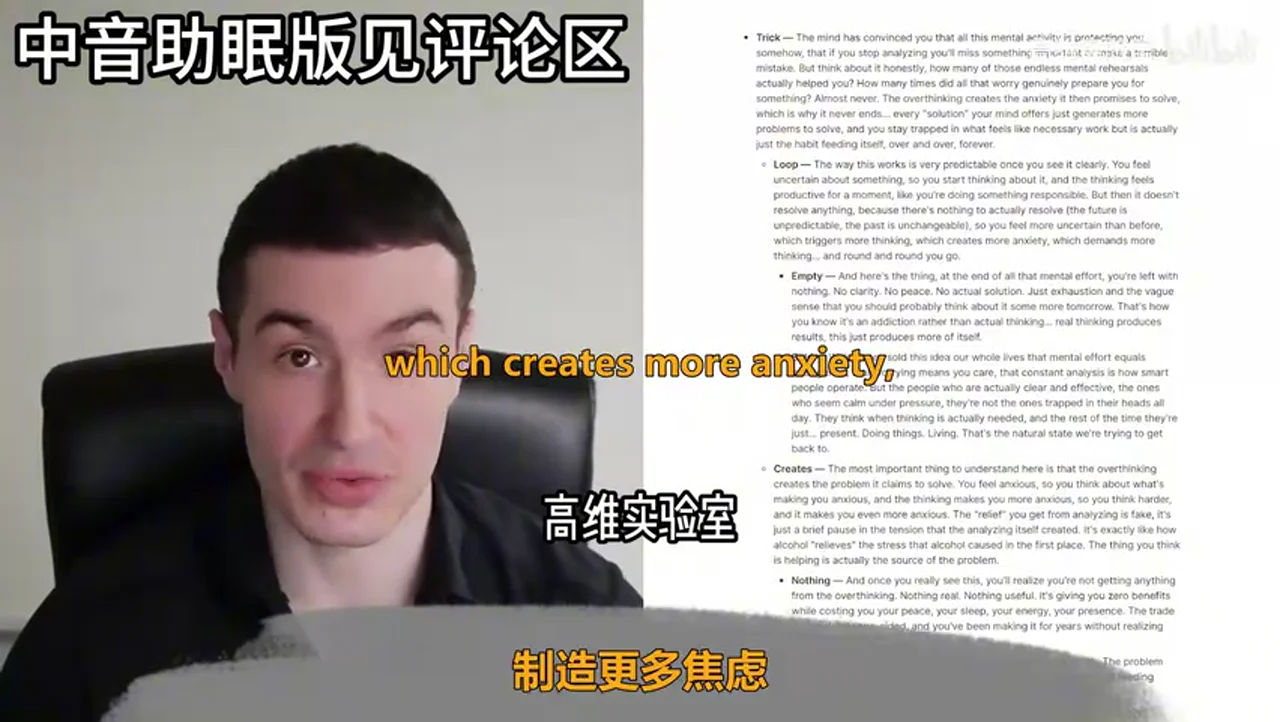
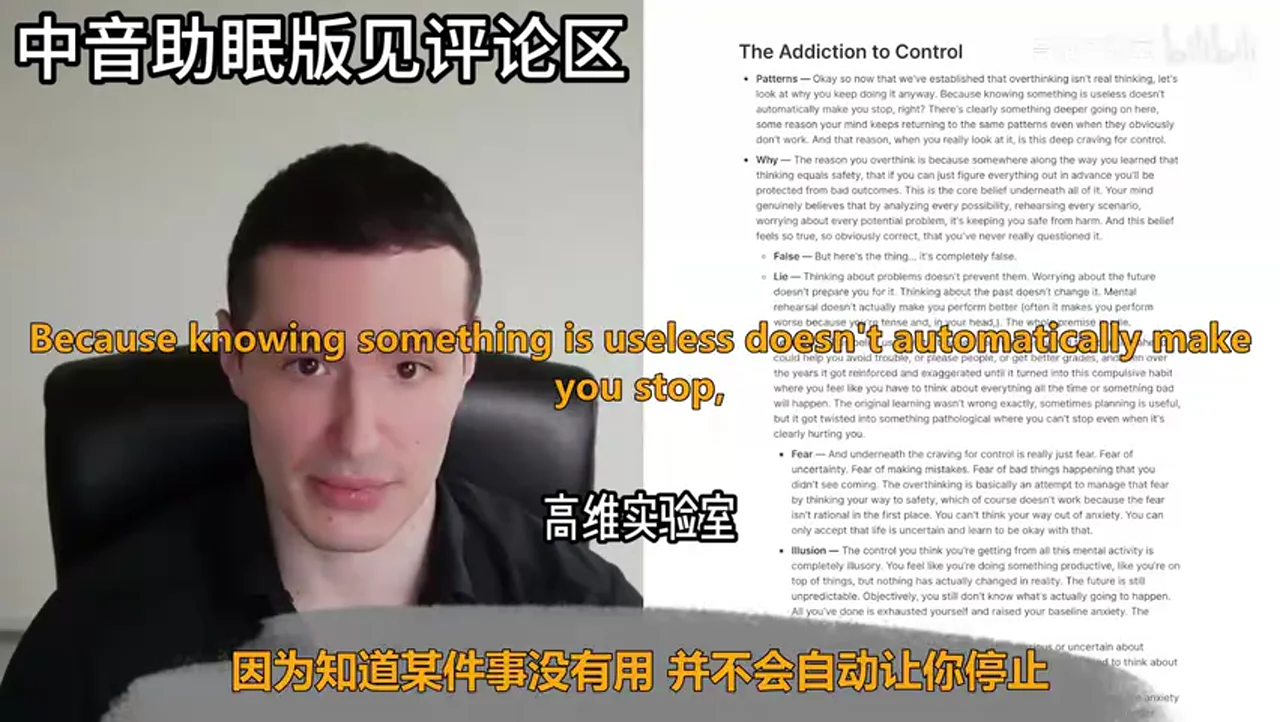
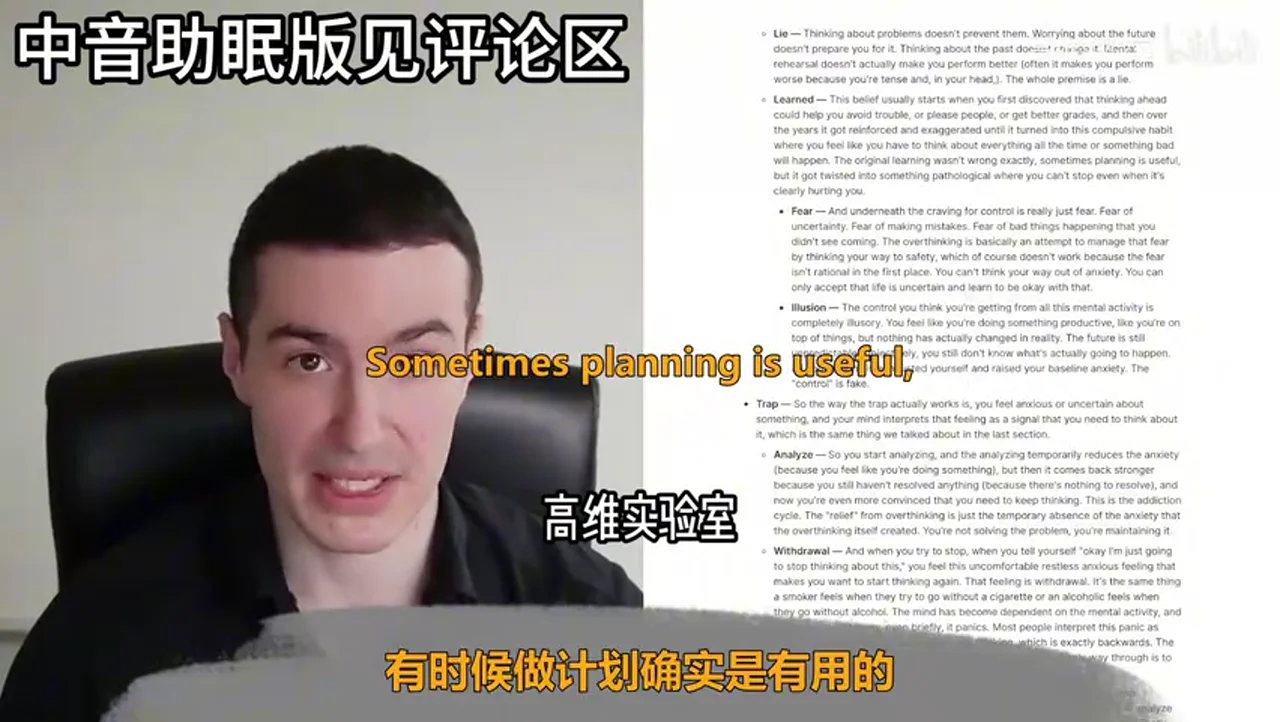
 2. 解释“控制感”如何维持循环。 视频认为,不确定感会被误读为“必须继续分析”的信号;短暂缓解又强化了继续分析的冲动。这个机制可作为理解讲者观点的模型,而非已被本视频证明的普遍因果规律。
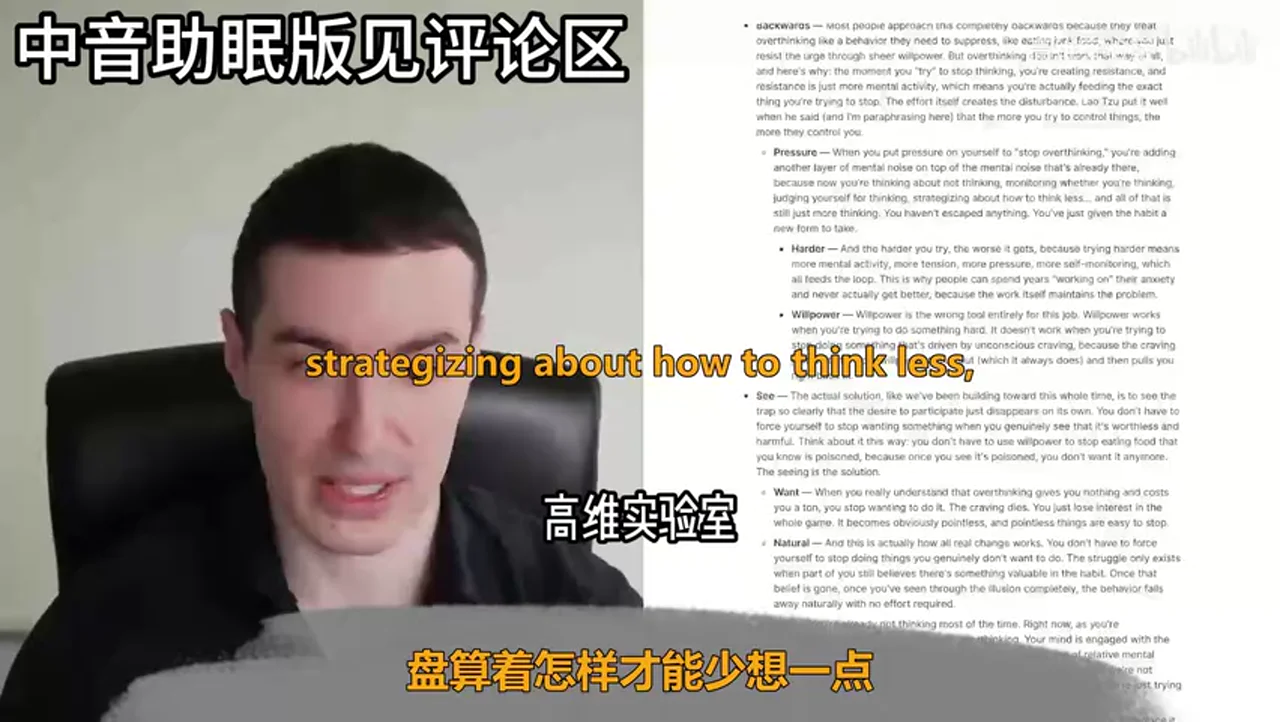
3. 提出“不再参与”的介入点。 讲者反对用更强的意志力压制想法,主张先看见循环、允许不适存在,并停止把每个担忧都当成必须处理的任务。
4. 把注意力落到方向与行动。 视频建议写下一个当前目标、项目或下一步,让注意力有现实对象;其意图是把精力从重复推演转回可执行事项。这里的“目标/目的”是讲者的自助框架,不是焦虑或强迫性体验的替代治疗。
2. 解释“控制感”如何维持循环。 视频认为,不确定感会被误读为“必须继续分析”的信号;短暂缓解又强化了继续分析的冲动。这个机制可作为理解讲者观点的模型,而非已被本视频证明的普遍因果规律。
3. 提出“不再参与”的介入点。 讲者反对用更强的意志力压制想法,主张先看见循环、允许不适存在,并停止把每个担忧都当成必须处理的任务。
4. 把注意力落到方向与行动。 视频建议写下一个当前目标、项目或下一步,让注意力有现实对象;其意图是把精力从重复推演转回可执行事项。这里的“目标/目的”是讲者的自助框架,不是焦虑或强迫性体验的替代治疗。
可以保留的学习收获
- 用一个朴素问题检查当下思考:它是否正服务于一个明确决策,并产生可验证的下一步? 若是,可继续限定范围地思考;若不是,可能值得暂停反复推演、把问题写下来或回到当前任务。
- 不必把每个念头都当成命令。把“我正在出现一个担忧”与“我必须立刻继续分析它”分开,是一个有用的自我观察角度;这不是要求消灭念头,也不是保证症状会消失。
- 目标可以作为注意力的落点,但宜小而具体:例如今天能开始的一个项目步骤、一次散步或一个待办动作。衡量标准是它是否帮助你回到现实行动,而不是承诺它会自动降低焦虑。
事实核验结论
| 视频中的表述 | 核验结果 | 应如何理解 |
|---|---|---|
| 把长期重复、无解的思考称为 “rumination(反刍)” | 部分成立 | APA 的定义支持“过度、重复的观念性思考”这一描述,但不能据一次视频或自我感受判断临床问题,更不能据此诊断焦虑障碍或 OCD。 |
| 过度思考等于成瘾;不适就是与烟、酒、药物相同的戒断 | 矛盾/不成立 | NIDA 对物质成瘾的说明并不能把一般“过度思考”直接等同为成瘾;焦虑、不适或短暂缓解本身都不足以证明“成瘾”。 |
| 不需要治疗、冥想或自我改善;治疗会维持问题 | 与证据相矛盾 | NIMH:心理治疗与现行的NIMH:广泛性焦虑障碍资料都说明,心理治疗(包括 CBT)和其他个体化支持可为合适的选择。并非每个人都需要治疗,但视频不应一概否定它。 |
| 只要不参与循环,不适会自行过去并永久消失;这是唯一方法 | 部分成立但严重过度泛化 | 针对某些强迫症状,循证的 ERP 会在安全、渐进、通常有专业支持的条件下练习面对触发物并减少仪式行为;这不能推出“任何人只靠一次看清就永久解决”。参见 NIMH:OCD。 |
| 明确人生目的/写下目标是最有效的终结方式 | 未核实 | 有意义的目标和行动可能对部分人的专注与生活组织有帮助,但视频没有给出可支持“最有效”“自然消除”或适用于所有人的比较证据。 |
使用边界
将视频当作一次对“无效循环”与“可行动问题”之间差别的提醒更稳妥,而不要把它当作“一劳永逸”地解决焦虑、侵入性想法或强迫行为的方法。若反复且难以控制的侵入性想法、强迫行为、显著焦虑、失眠或日常功能受损持续存在,应咨询合格的医疗或心理健康专业人士;如有自伤、自杀或紧急安全风险,应立即联系当地急救服务或危机干预资源。
辅助理解
先把三层内容分开
视频观点:讲者认为“过度思考”是靠控制感和短暂缓解维持的循环;看清它后,不参与、转向行动即可自然结束。
外部证据:反复性思考可以是描述性的“反刍”概念,但它不等于成瘾或诊断;心理治疗并非多余,是否需要何种支持应依据具体症状与个人情况评估。
低风险实践:对一般性的日常担忧,可以试着把注意力从“再想一遍”转向“有没有一个当前可做、可结束的小动作”。这是一种注意力与任务管理练习,不是治疗,也不应拿来压制、解释或否认显著痛苦。
视频的论证结构,而非临床模型
flowchart TD
    A["不确定感、担忧或未完成感"] --> B["反复分析/心理模拟"]
    B --> C["短暂出现‘我正在处理’的感觉"]
    C --> D["现实问题未改变,或不确定性仍在"]
    D --> E["更强的不安与继续分析的冲动"]
    E --> B
    E -.-> G["视频建议:辨认循环后转回现实行动"]
    G --> F["一个具体、可执行的当前任务"]
上图准确复现的是视频的解释路线:它把焦虑、控制感和重复分析串成循环,并把行动视为出口。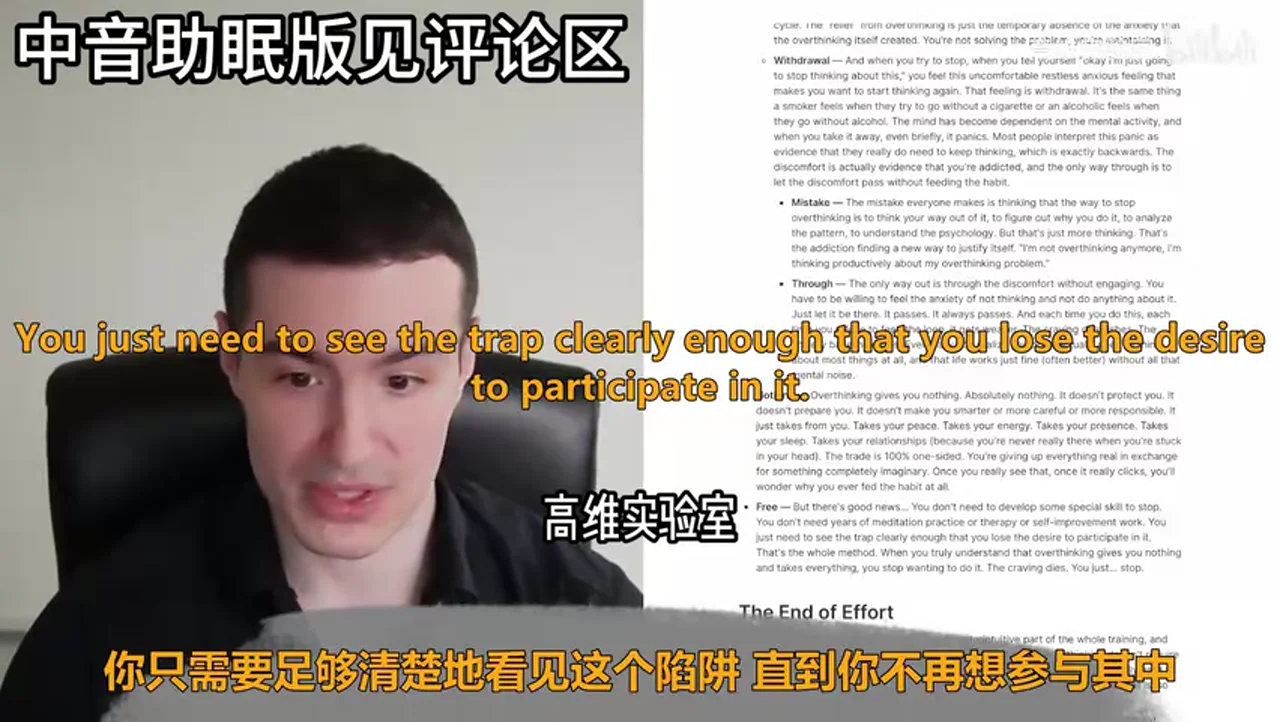 仅在此处帮助定位讲者“看见陷阱、停止参与”的论点。它不证明“看见即可治愈”,也不意味着面对所有侵入性想法都应自行处理。
更精确地阅读几个关键句
| 视频的强断言 | 更稳妥的改写 | 核验状态 |
|---|---|---|
| “想很多就是不真实的思考。” | 反复且没有新增信息、决策或行动的推演,可能不再有助于当前问题;复杂研究、哀伤整理或实际规划不应被一概归为“噪音”。 | “反刍”作为描述性术语为部分成立;不能用于诊断。 |
| “不适是戒断,说明已经成瘾。” | 停止反复分析时出现不安,值得温和观察,但这种感觉不能单独定义为成瘾或戒断。 | 矛盾/不成立;参见 NIDA。 |
| “别靠治疗或意志力;唯一办法是不参与。” | 有些人会发现减少反复推演、回到行动有帮助;但可由合格专业人员提供的循证心理治疗(如适用)、药物或其他个体化支持也可能是合适选项。 | “唯一办法/无需治疗”与 NIMH 心理治疗资料 及 NIMH:广泛性焦虑障碍 相矛盾。 |
| “有目标就会让心安静,最有效。” | 写下一个有意义、可开始的目标,可能帮助组织注意力和下一步;不应承诺它能消除焦虑或取代临床支持。 | 未核实。 |
一个低风险的行动—复盘卡
适用于一般的工作、学习或生活担忧;目的不是让念头消失,而是把“模糊推演”改写成可观察的信息。
- 写下当前反复出现的题目,不判断它“对不对”。
- 问两个问题:现在是否需要做决定?我能在今天完成的最小下一步是什么?
- 若有下一步,把它限定为一个可完成动作,例如查一项资料、发一封必要邮件、整理一页清单或约定讨论时间;做完后再决定是否需要继续思考。
- 若暂时没有可做的下一步,给它一个明确的稍后复看时间,然后选择一项中性、现实的活动(如吃饭、洗漱、散步或继续既定工作)。这不是“禁止思考”,而是避免无限延长同一轮推演。
- 复盘时只记录:这一步是否让问题更清楚、是否产生了新信息、是否需要调整行动。不要以“我有没有彻底不焦虑”作为成败指标。
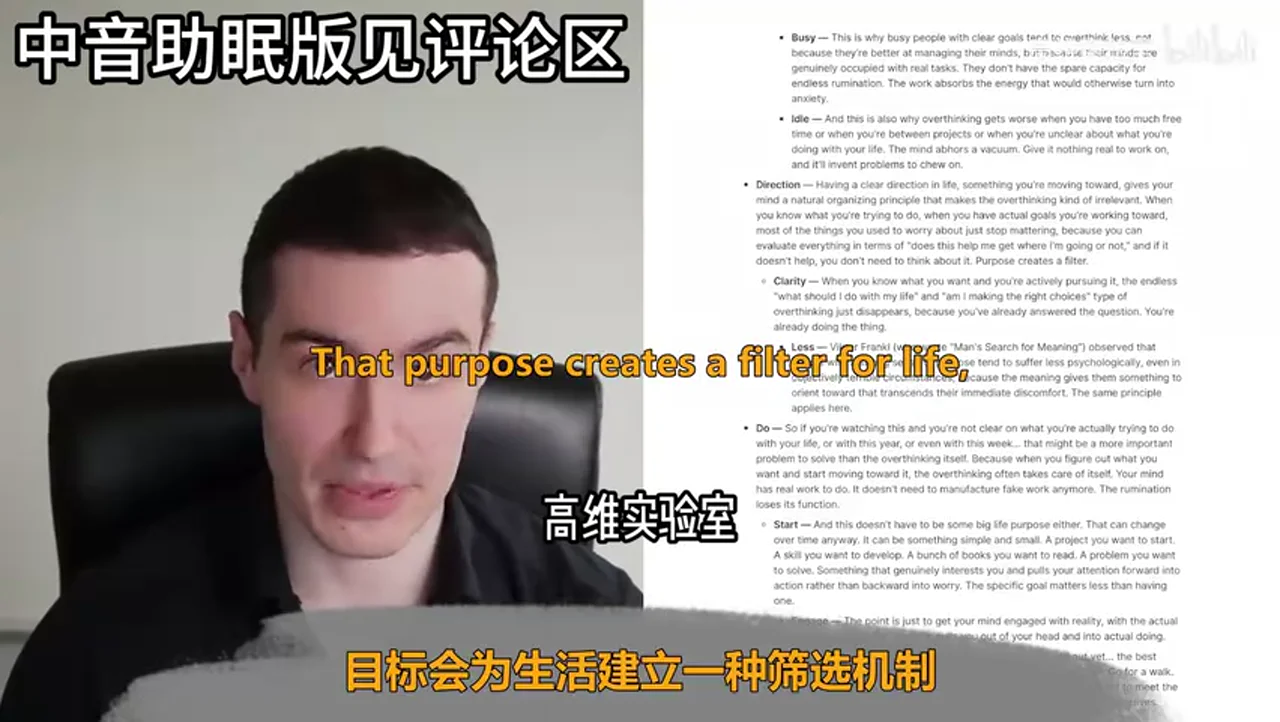 可放在第 2–4 步附近,说明视频把“目的/方向”当作生活的筛选器。更准确的用法是:让目标协助选择下一步,而不是相信目标必然消除任何心理困扰。
何时不应只靠这套框架
若出现持续且难以控制的侵入性想法、强迫行为、明显恐慌或焦虑、睡眠和日常功能显著受影响,或上述练习使痛苦增加,请不要把它解释成“自己还不够看清陷阱”。可向合格的医疗或心理健康专业人士求助;NIMH 关于 OCD 的资料说明了循证支持的路径。出现自伤、自杀或紧急安全风险时,应立即联系当地急救服务或危机干预资源。
Data
增强转写稿
[00:00] Alright hello and welcome to this training as you can see from the title what we’re going to be covering is how to stop overthinking and as you can see from the overview what we’re going to be talking about more specifically is first the overview itself the illusion of thinking the addiction to control the end of effort the power of purpose the natural end of overthinking the review and your action items for the day or the next few days. [00:24] Let’s get started and talk about the illusion of thinking. [00:28] Alright, so if you’re watching or listening to this, then you probably already know what it feels like to be stuck in your own head. [00:35] It could be you’re lying in bed at night replaying a conversation from three days ago or from three years ago for that matter, or you’re sitting at your desk supposedly working but your mind is really running through every possible way. [00:48] Some future thing could go wrong, you catch yourself mid-spiral tell yourself to stop and five minutes later you’re right back in it that loop that exhausting inability to just stop. [01:00] I’ve been there most people have, but the thing I want you to understand is that what you’re dealing with is actually something very specific, almost like a program that is really running in the background that you didn’t install and never agreed to and once you see how it actually works, you can turn it off. [01:17] That’s what this training is all about.We’re going to break down exactly what’s happening when your mind won’t shut up. [01:24] Why it feels so impossible to escape and then I’m going to show you how to actually get free, not through years of meditation or therapy or willpower, but through simply seeing something clearly that you’ve never seen before. [01:35] Now, the first thing I need you to understand is that most of what you call thinking isn’t actually thinking at all.It’s just mental noise.Real thinking is actually very rare.It’s focused.It’s intentional.It has a purpose and it produces something useful at the end. [01:49] What most people do when they’re stuck in their heads and probably what you’re doing at 2am when you can’t sleep is just replaying, recycling or rearranging the same fears and doubts over and over again, which feels like you’re working on something important, but you’re really just running in place, right? [02:05] And this is the trap.You believe you’re being responsible or careful or thorough that you’re thinking things through when actually you’re just running the same broken loop. [02:15] Now, there’s a massive difference between actual thinking and what we’re calling overthinking, right? Real thinking has a direction.You sit down, you work through a problem, you arrive at something and then you’re done. [02:27] Overthinking has no direction.It’s circular.You go round and round the same territory without ever landing anywhere.And an hour later you’re more confused than when you actually started.Real thinking leaves you feeling clearer.Overthinking leaves you feeling drained and anxious.Real thinking is something you choose to do. [02:49] Overthinking is something that actually happens to you, right? Often against your will.And here’s a simple test.If you’ve been thinking about the same thing for days or weeks or months and you’re no closer to a resolution, that’s not thinking, right? [03:06] That’s rumination.That’s a mental habit running on autopilot.Real thinking doesn’t take that long unless you’re solving some big academic research problem, right?Because real thinking actually goes somewhere. [03:20] The tricky part is that the mind confuses these two things on purpose because as long as you believe that overthinking is useful, you’ll keep feeding it.The moment you see that it’s not useful, that it never was, the whole thing starts to fall apart. [03:34] Now, the mind has convinced you that all this mental activity is actually protecting you somehow.That if you stop analyzing, you’ll miss something important or make a terrible mistake. [03:44] But think about it honestly, right?How many of those endless mental rehearsals actually helped you?How many times did all that worry genuinely prepare you for something? [03:55] Almost never.The overthinking creates the anxiety it then promises to solve,which is why it never ends.Every solution your mind offers just generates more problems to solve. [04:08] And you stay trapped in what feels like necessary work,but it’s actually just the habit feeding itself over and over and over again forever, right? [04:17] The way this works is very predictable once you see it clearly.You feel uncertain about something so you start thinking about it and then the thinking feels productive for a moment like you’re actually doing something responsible, [04:29] but then it doesn’t resolve anything because there’s nothing to actually resolve because the future is unpredictable and the past is unchangeable. [04:37] So you feel more uncertain than you were before,which triggers more thinking,which creates more anxiety,which demands more thinking and round and round you go,right? [04:48] And the thing is,at the end of all this mental effort,you’re actually left with nothing.No clarity,no peace,no actual solution. [04:56] Just exhaustion and the vague sense that you should probably think about it some more tomorrow,right? [05:02] That’s how you know it’s an addiction rather than actual thinking.Real thinking produces results.This just produces more of itself. [05:10] We’ve been sold this idea our whole lives that mental effort equals intelligence,that worrying means you care,that constant analysis is how smart people operate. [05:21] That’s not the case,right?The people who are actually clear and effective,the ones who seem calm under pressure,they’re not the ones trapped in their heads all the time. [05:31] They think when thinking is actually needed,and the rest of the time they’re just present,they’re just there doing things,living,solving problems when they need to. [05:43] That’s the natural state we’re trying to get back to.And the most important thing to understand here is that the overthinking creates the problem it claims to solve. [05:52] You feel anxious so you think about what’s making you anxious,and the thinking makes you more anxious so you think harder and it makes you even more anxious. [06:01] The relief you get from analyzing is fake.It’s just a brief pause in the tension that the analyzing itself actually created. [06:09] It’s exactly how alcohol relieves the stress that alcohol caused in the first place. [06:17] The thing you think is helping is actually the source of the problem,right? [06:22] And once you really see this,you’ll realize you’re not getting anything from the overthinking,nothing real,nothing useful. [06:28] It’s giving you zero benefits while costing you your peace,your sleep,your energy,your presence,right? [06:35] The trade is completely one-sided and you’ve been making it for years without realizing how bad the deal actually is. [06:42] See,the problem was never that you think too much.The problem was that you mistook overthinking for real thinking. [06:49] And so you kept feeding something that was never actually serving you. [06:53] And this should come as a huge relief because if overthinking were actually thinking,you’d be in real trouble,right? [07:00] You’d need to somehow stop your own intelligence from working,which would be impossible. [07:05] But that’s not what’s happening here,right? [07:07] You’re just caught in a mental habit that has nothing to do with your actual capacity to reason or solve problems or make decisions. [07:15] The real you,the one who can actually think clearly and act decisively when it’s actually needed,is still there underneath all that noise. [07:23] You don’t need to become someone different or develop some new skill. [07:27] We just need to stop feeding the habit so the real version of you that can actually solve problems and think when it’s needed can come back. [07:35] So let’s talk about the addiction to control. [07:39] So now that we’ve established that overthinking isn’t real thinking,let’s look at why you keep doing it anyway. [07:46] Because knowing something is useless doesn’t automatically make you stop,right? [07:51] There’s clearly something deeper going on here. [07:53] Some reason your mind keeps returning to the same patterns even when they obviously don’t work. [07:58] And that reason when you really look at it is this deep craving for control. [08:03] The reason you overthink is because somewhere along the way you learn that thinking equals safety. [08:09] That if you can just figure out everything in advance,you’ll be protected from bad outcomes. [08:14] This is the core belief underneath all of it,right? [08:17] Your mind genuinely believes that by analyzing every possibility,rehearsing every scenario,worrying about every potential problem,it’s keeping you safe from harm. [08:27] And this belief feels so true,so obviously correct that you’ve never really questioned it. [08:33] But here’s the thing,it is completely false. [08:36] Thinking about problems doesn’t actually prevent them,right? [08:39] Think about it,worrying about the future doesn’t really prepare you for it. [08:44] Thinking about the past doesn’t really change it. [08:47] Mental rehearsal doesn’t actually make you perform better. [08:51] Often it makes you perform worse because you’re tense and in your head.The whole premise is a lie. [08:59] So this belief usually starts when you first discovered that thinking ahead could actually help you avoid trouble or please people or get better grades. [09:07] And then over the years it got reinforced and exaggerated until it turned into this compulsive habit where you feel like you have to think about everything all the time or something bad will happen. [09:18] The original learning wasn’t wrong exactly,right? [09:22] Sometimes planning is useful,but it got twisted into something pathological where you can’t even stop when it’s clearly hurting you. [09:32] And underneath the craving for control is really just fear,fear of uncertainty,fear of making mistakes,fear of bad things happening that you didn’t see coming. [09:43] And fear that if you didn’t see them coming then you’re maybe not as perfect as you thought you were,right? [09:51] The overthinking is basically an attempt to manage that fear by thinking your way to safety,which of course doesn’t work because the fear isn’t rational in the first place. [10:02] You can’t think your way out of anxiety.You can only accept that life is uncertain and learn to be okay with that. [10:09] And learn to be okay with the fact that you won’t be able to see everything ahead of time. [10:14] And that that doesn’t mean that,I mean it does mean that you’re imperfect,right?And that’s okay. [10:21] The control you think you’re getting from all this mental activity is completely illusory. [10:26] You feel like you’re doing something productive like you’re on top of things,but nothing has actually changed in reality. [10:33] The future is still unpredictable and it’s still going to happen.Objectively you still don’t know what’s actually going to happen. [10:40] All you’ve done is exhausted yourself and raised your baseline anxiety.The control is fake. [10:46] There is no control there.So the way the trap actually works is you feel anxious or uncertain about something [10:54] and then your mind interprets that feeling as a signal that you need to think about it,which is the same thing we talked about in the last section,right? [11:02] So you start analyzing,and the analyzing temporarily reduces the anxiety because you feel like you’re doing something. [11:09] But then it comes back stronger because you still haven’t resolved anything because there’s nothing to resolve. [11:14] And now you’re even more convinced that you need to keep thinking. [11:18] And this is the addiction cycle.The relief from overthinking is just the temporary absence of the anxiety that the overthinking itself created. [11:28] You’re not solving the problem,you’re maintaining it.And when you try to stop when you tell yourself, [11:34] Okay,I’m just going to stop thinking about this.You feel this uncomfortable,restless anxious feeling that makes you want to start thinking again. [11:42] That feeling is withdrawal,right?It’s the same thing a smoker feels when they try to go without a cigarette or an alcoholic feels [11:50] when they go without alcohol or any drug addict when they go without their drug of choice. [11:57] The mind has become dependent on the mental activity,and when you take it away,even briefly,it panics. [12:04] And most people interpret this panic as evidence that they really do need to keep thinking,which is exactly backwards. [12:12] The discomfort is actually evidence that you are addicted,and the only way through is to let the discomfort pass without feeding the habit. [12:22] Now,the mistake everyone makes is thinking that the way to stop overthinking is to think your way out of it. [12:28] To figure out why you do it,to analyze the pattern,to understand the psychology. [12:33] But that’s just more thinking,right?That’s the addiction finding a new way to basically justify itself. [12:41] I’m not overthinking anymore.I’m just thinking productively about my overthinking problem. [12:46] Do you see how that sounds?The only way out is really through the discomfort without engaging. [12:53] You have to be willing to feel the anxiety of not thinking and not do anything about it. [12:58] That’s all.Just let it be there.It passes.It always passes. [13:02] And each time you do this,each time you refuse to feed the loop,it gets weaker. [13:07] And the craving diminishes.The anxiety baseline drops. [13:11] Eventually,you realize that you don’t actually need to think about most things at all. [13:16] And that life just works itself out fine. [13:19] Often better without all that mental noise,right? [13:22] So overthinking gives you nothing,absolutely nothing,and it doesn’t protect you. [13:26] It doesn’t prepare you.It doesn’t make you smarter or more careful or more responsible. [13:31] It just takes from you.It takes your peace.It takes your energy.It takes your presence. [13:35] It takes your sleep.And it takes your relationships because you’re never really there when you’re stuck in your head. [13:41] The trade is 100% one-sided.You’re giving up everything real in exchange for something completely imaginary. [13:50] And once you really see that,once it really clicks,you’ll wonder why you ever fed the habit at all. [13:56] But there’s good news.You don’t need to develop some special skill to stop. [14:00] You don’t need years of meditation practice or therapy or self-improvement work. [14:05] You just need to see the trap clearly enough that you lose the desire to participate in it. [14:10] That’s the whole method.When you truly understand that overthinking gives you nothing and takes everything, [14:15] you stop wanting to do it.The craving dies.You just stop,right? [14:20] So let’s talk about the end of effort. [14:22] So this is maybe the most counterintuitive part of the whole training. [14:27] And it’s also probably the most important,which is that stopping overthinking doesn’t require effort. [14:34] Like at all.In fact,effort is the problem. [14:37] The whole “I’m going to try really hard to stop thinking” approach is doomed from the start. [14:42] And I want to explain why that is so that you don’t waste time doing it wrong. [14:47] Now most people approach this completely backwards because they treat overthinking like a behavior they need to suppress. [14:53] Like it’s eating junk food,where you just resist the urge through sheer willpower. [14:58] But overthinking doesn’t work that way at all. [15:01] And here’s why.The moment you try to stop thinking,you’re creating resistance,right? [15:06] And resistance is just more mental activity,which means you’re actually feeding the exact thing you’re trying to stop. [15:13] The effort itself creates the disturbance. [15:16] Lao Tzu put it really well when he said,and I’m paraphrasing here, [15:20] that the more you try to control things,the more they control you,right? [15:24] And the same goes for this,when you put pressure on yourself to stop overthinking, [15:28] you’re adding another layer of mental noise on top of the mental noise that’s already there. [15:33] Because now you’re thinking about not thinking,monitoring whether you’re thinking,judging yourself for thinking, [15:38] strategizing about how to think less.And all of that is just still more thinking,right? [15:43] You haven’t escaped anything.You’ve just given the habit a new form to take. [15:48] And the harder you try,the worse it gets.Because trying harder means more mental activity, [15:53] more attention,more pressure,more self-monitoring,which all feeds the loop. [15:57] This is why people can spend years working on their anxiety problem [16:01] and never actually get better because the work itself maintains the problem,right? [16:07] willpower is the wrong tool entirely for this job. [16:10] Willpower works when you’re trying to do something hard for the first time. [16:15] It doesn’t work when you’re trying to stop doing something that’s driven by unconscious craving. [16:20] Because the craving just waits for your willpower to run out,right? [16:24] Which it always does,especially at the end of our day,right? [16:28] And then it pulls you right back in. [16:30] Now the actual solution,like we’ve been building towards this whole time [16:34] is to see the trap so clearly that the desire to participate just disappears on its own. [16:39] You don’t have to force yourself to stop wanting something when you genuinely see it for what it is. [16:45] And when you see that it’s worthless and harmful. [16:48] Think about it this way,you don’t have to use willpower to stop eating food that you know is poisoned,right? [16:54] Because once you see it’s poisoned,you don’t want it anymore. [16:57] The seeing is the solution. [17:00] So when you really understand that overthinking gives you nothing and costs you a ton, [17:05] you stop wanting to do it.The craving dies,you just lose interest in the whole game. [17:09] It becomes obviously pointless and pointless things are easy to stop. [17:13] And this is actually how all real change works. [17:16] You don’t have to force yourself to stop doing things you genuinely don’t want to do. [17:21] The struggle only exists when a part of you still believes there’s something valuable in the habit. [17:26] Once that belief is gone,once you’ve seen through the illusion,because it is an illusion [17:31] and once you’ve seen through that completely,the behavior falls away naturally with no effort required. [17:37] So you’re already not thinking most of the time. [17:40] Right now,as you’re watching or listening to this,or if you’re reading it,you’re not really overthinking,right? [17:47] Your mind is engaged with the content following along and it’s present. [17:51] The natural state is already one of relative mental quiet,right? [17:56] The overthinking is an interruption of that state,not the default,right? [18:00] So we’re not trying to create something new or achieve some advanced mental state. [18:05] We’re just actually trying to stop interrupting the peace that’s already there underneath the noise. [18:10] We’re just going back to where we naturally are. [18:14] And when you stop feeding the overthinking habit,you don’t have to replace it with something or build a new skill or develop a practice. [18:22] You just return to what was already there before the habit took over. [18:26] Peace isn’t something you build,right?It’s what remains when you stop creating anxiety when there’s no chaos. [18:32] That’s peace,right?So the instruction here isn’t try harder to stop thinking. [18:37] The instruction is more like allow yourself to stop,right? [18:41] Give yourself permission to not engage with it. [18:44] Stop treating every worry thought like it deserves your attention because it doesn’t.It’s just thoughts,right? [18:51] They’re just,there’s a thousands of thousands of them a day.You can’t pay attention to each one of them. [18:59] And trust that you’ll be fine,that you don’t need all that mental activity to function or to stay safe or to make good decisions. [19:06] You’ve been sold the idea that you need to think consistently and constantly,but you don’t. [19:12] Most of life works perfectly fine,right? [19:15] It’s often better without you really trying to figure it all out in advance. [19:21] So with that said,let’s talk about the power of purpose. [19:24] So the single most effective thing you can actually do to end overthinking is to have something real to do,right? [19:31] Like an actual purpose,a goal,something you’re actively moving towards that demands your attention and energy. [19:37] And a written goal,even better,not a goal in your head that you overthink about. [19:43] Because overthinking doesn’t just happen in a vacuum.It happens when your mind has nothing better to do,which is why you’ll notice it’s always worse when you’re idle or bored or directionless. [19:54] Nature abhors a vacuum,right? [19:57] Overthinking thrives in a vacuum of purpose. [20:02] Your mind is constantly looking for something to do,something to work on,something to process. [20:07] And if you don’t give it something meaningful and real to engage with,it will just manufacture problems to solve,which is what overthinking is. [20:15] The anxious overthinking fills the space that purpose should be filling. [20:20] So in a weird way,the question isn’t really how do I stop overthinking,it’s what should I be doing instead. [20:27] And once you have a clear answer to that second question,the first one tends to solve itself. [20:33] So stagnant mental energy with nowhere productive to go turns into overthinking. [20:38] But when you have a clear purpose,something you’re actively building or working towards or trying to achieve,that energy gets channeled naturally into real productive thought and action. [20:48] And there’s simply less left over to waste on circular thinking,there’s less energy literally. [20:53] And this is why busy people with clear goals that are written down tend to overthink less,not because they’re better at managing their minds. [21:00] But because their minds are genuinely occupied with real tasks,other things to worry about,right? [21:06] They don’t have the spare capacity for endless rumination. [21:10] The work absorbs the energy that would otherwise turn into anxiety. [21:14] And this is also why overthinking gets worse when you have too much free time or when you’re between projects or when you’re unclear about what you’re doing with your life. [21:24] Or when you’re in between jobs,the mind abhors a vacuum,give it nothing real to work on and it will invent problems to chew on. [21:32] So having a clear direction in life,something you’re actually moving towards,gives your mind a natural organizing principle that makes the overthinking kind of irrelevant. [21:41] When you know what you’re trying to do,when you have actual goals you’re working towards,most of the things you used to worry about just stop mattering because you can evaluate everything in terms of does this help me get where I’m going or not. [21:53] And if it doesn’t help,you don’t need to think about it.That purpose creates a filter for life,right? [22:00] And when you know what you want and you’re actively pursuing it,the endless what should I do with my life and am I making the right choices type of overthinking just disappears. [22:10] Because you’ve already answered the question,you’re already doing the thing. [22:14] And Viktor Frankl,who wrote Man’s Search for Meaning,observed that people with a strong sense of purpose tend to suffer less psychologically,even in objectively terrible circumstances because the meaning gives them something to orient towards that transcends their immediate discomfort. [22:29] The same principle applies here,right?So if you’re watching this and you’re not clear on what you’re actually trying to do with your life,or with this year,or even with this week,that might be a more important problem to solve than the overthinking itself. [22:43] Because when you figure out what you want and start moving towards it,the overthinking often takes care of itself,your mind has real work to do.It doesn’t need to manufacture fake work anymore. [22:54] The rumination loses its function.And this doesn’t have to be some big life purpose either,right?That can change over time anyway. [23:02] It can be something simple and small,a project you want to start,a skill you want to develop,a hobby you want to start,a bunch of books you want to read,a problem you want to solve,something that genuinely interests you and pulls your attention forward into action rather than backwards into worry. [23:18] The specific goals matter less than having one and having it written down.The point is just to get your mind engaged with reality,with the actual world in front of you.Purpose pulls you out of your head and into actual doing. [23:32] And even if you don’t have any of that figured out yet,the best thing you can do is just do something,anything,clean your room,go for a walk,start a task you’ve been avoiding.There’s an old saying that if you want to meet the devil,just do nothing and he’ll come for you,right? [23:47] Idleness is where overthinking lives; movement and action are where it dies,right?And the beautiful thing is that when you’re actually engaged in purposeful work,the mental state you’re trying to achieve through all this effort just shows up naturally. [24:02] The presence,the flow,the quiet mind,these aren’t things you have to manufacture.They’re a natural byproduct of being absorbed in something that matters to you.They’re a natural byproduct of purpose.They just show up,right?They’re inherent. [24:17] So the,let’s talk about the natural end of overthinking.So if you’ve been following along,you should be starting to see something pretty clear by now,which is that overthinking isn’t really something you need to fight or fix or overcome through effort.It’s something that ends naturally once you stop feeding it and once you see it for what it truly is. [24:42] There’s usually a moment and it might happen while you’re watching this or it might happen later when you’re going about your day where something just clicks and you realize you’ve been doing something completely pointless for years,maybe decades. [24:55] And you suddenly see that you don’t have to do it anymore because there’s generally nothing in it for you.That moment is the beginning of the end. [25:03] Once you’ve really seen that overthinking gives you absolutely nothing,that the control is fake,that the preparation doesn’t actually prepare you,that the whole thing is just an addiction pretending to be responsibility,you can’t unsee it. [25:18] And when that desire is gone,you don’t have to do anything special to maintain your freedom.You’re not constantly fighting urges or using techniques to stay present or reminding yourself not to think too much. [25:30] You’re just free,right?And this is completely different than using willpower where you’re constantly battling your own mind and the best you can hope for is a temporary victory before the next overthinking episode. [25:44] This is permanent.This is easy because you’re not suppressing anything.You’ve just lost interest because here’s the thing you need to really get overthinking is an addiction. [25:53] And like any addiction,it’s a vicious cycle that perpetuates itself,right?The relief you get from overthinking only relieves the anxiety that the overthinking itself created in the first place. [26:05] It’s completely circular.It feeds on itself and once you start the cycle,it doesn’t end on its own.It just keeps going until you’re exhausted and it runs out of fuel for the night only to start again tomorrow. [26:20] So the only way to actually stop is to make a firm decision that you will not entertain the cycle,that you will not start it,right? [26:28] Not I’ll try to think less,no,not,or,you know,I’ll notice when I’m overthinking and then stop.No,right?The decision is I’m not starting.That’s the decision period because once you start,you’re already in the loop. [26:43] And the loop is self-sustaining.It perpetuates itself.If you started,it continues.Your goal isn’t to stop overthinking once it’s happening.Your goal is to notice the cycle trying to begin and just not start,just not participate,right? [27:01] So what does life actually look like on the other side of this?It’s honestly kind of boring to describe,right?You just live.You deal with things as they come up. [27:10] You think when thinking is actually useful,like when you’re solving a real problem or planning something concrete,and then the rest of the time you’re just present,engaged with whatever’s in front of you,and you’re not lost in some mental simulation of a future that doesn’t exist yet,or a past that’s already gone and unchangeable. [27:27] And the weird thing is,you actually perform better at life when you’re not overthinking,right?Your decisions are clearer because they don’t come from anxiety.Your relationships are better because you’re actually there. [27:39] Your work is better because you can actually focus.The thing you feared losing,the edge you thought that the overthinking gave you was never real,right?And you start to trust yourself that you can actually handle whatever comes up in the moment without having to rehearse it in advance. [27:56] Life becomes way more fluid and just more alive.The constant need to prepare and analyze and figure things out in advance,it just dissolves,and you become someone who can actually respond to life as it happens rather than living in their head. [28:10] And that’s when life becomes beautiful,with its ups and downs,right?So that’s it,really overthinking is really an illusion disguised as thinking.It gives you nothing and costs you everything,and you don’t stop it through effort. [28:24] You stop it by seeing through it so clearly that you lose the desire to do it.And when you have something real to move towards something that engages your mind and energy in a meaningful direction,the overthinking loses its function entirely and dies on its own. [28:39] That’s the method,that’s all it is.And if you’ve been paying attention,really paying attention,you might be there already,right?You might have already felt something changing.You might have had this aha moment during this training. [28:54] Because of,oh,I don’t actually have to do this anymore.And it really is that simple.We complicate things because we think things should be hard.And some are and some aren’t,right?That it should require years of work and discipline and struggle. [29:09] Some things do,some things don’t.But sometimes the deepest changes can really happen in an instant.The moment you see something clearly that was hidden before.And once you’ve seen it,you’re basically done.The only thing left is to just not go back,right? [29:25] And you won’t want to,because why would you return to something that gives you absolutely nothing.So,well,that said,let’s go over the review.We talked about the illusion of thinking,the addiction to control,the end of effort,the power of purpose,the natural end of overthinking,the review,and your action items for the day or the next few days. [29:45] First,recognize that what you’ve been calling thinking is actually just mental noise disguised as productivity.Real thinking has direction and it produces results.Overthinking is circular.It gives you nothing and it costs you everything.The control is fake.The preparation doesn’t actually prepare you. [30:04] And the moment you can tell the difference,you’ve already started to get free.Second,don’t try to fight or suppress the overthinking through willpower.That just adds more mental activity on top of the mental activity that’s already there.It just adds more thinking to the thinking. [30:20] Instead,let the craving die by seeing through the illusion so completely that you lose the desire to actually participate.When an old thought pattern starts up,just recognize it for what it is.Noise pretending to be useful,right?And let it pass without engaging. [30:37] And finally,get clear on what you’re actually trying to do with your life or with this year or even just this week or even just today.Have something real to move towards that demands your attention and energy.Purpose fills the vacuum that overthinking would otherwise fill.And it gives your mind something meaningful to engage with so it doesn’t have to manufacture fake problems to solve. [30:59] And if it’s late at night and you’re overthinking,then make sure you have set some goals for the next day so you can actually just focus on them,right?Focus on going to sleep so you can attack your goals the next day.That’s all you have to do.And don’t engage with the overthinking. [31:16] With that said, I hope you enjoyed this training.
原始转写稿
[00:00] Alright hello and welcome to this training as you can see from the title what we’re going to be covering is how to stop overthinking and as you can see from the overview what we’re going to be talking about more specifically is first the overview itself the illusion of thinking the addiction to control the end of effort the power of purpose the natural end of overthinking the review and your action items for the day or the next few days. [00:24] Let’s get started and talk about the illusion of thinking. [00:28] Alright so if you’re watching you watching or listening to this, then you probably already know what it feels like to be stuck in your own head. [00:35] It could be you’re lying in bed at night replaying a conversation from three days ago or from three years ago for that matter, or you’re sitting at your desk supposedly working but your mind is really running through every possible way. [00:48] Some future thing could go wrong, you catch yourself mid-spiral tell yourself to stop and five minutes later you’re right back in it that loop that exhausting inability to just stop. [01:00] I’ve been there most people have, but the thing I want you to understand is that what you’re dealing with is actually something very specific, almost like a program that is really running in the background that you didn’t install and never agreed to and once you see how it actually works, you can turn it off. [01:17] That’s what this training is all about.We’re going to break down exactly what’s happening when your mind won’t shut up. [01:24] Why it feels so impossible to escape and then I’m going to show you how to actually get free, not through years of meditation or therapy or willpower, but through simply seeing something clearly that you’ve never seen before. [01:35] Now, the first thing I need you to understand is that most of what you call thinking isn’t actually thinking at all.It’s just mental noise.Real thinking is actually very rare.It’s focused.It’s intentional.It has a purpose and it produces something useful at the end. [01:49] What most people do when they’re stuck in their hands and probably what you’re doing at 2am when you can sleep is just replaying, recycling or rearranging the same fears and doubts over and over again, which feels like you’re working on something important, but you’re really just running in place, right? [02:05] And this is the trap.You believe you’re being responsible or careful or thorough that you’re thinking things through when actually you’re just running the same broken loop. [02:15] Now, there’s a massive difference between actual thinking and what we’re calling overthinking, right? Real thinking has a direction.You sit down, you work through a problem, you arrive at something and then you’re done. [02:27] Overthinking has no direction.It’s circular.You go round and round the same territory without ever landing anywhere.And an hour later you’re more confused than when you actually started.Real thinking leaves you feeling clearer.Overthinking leaves you feeling drained and anxious.Real thinking is something you choose to do. [02:49] Overthinking is something that actually happens to you, right? Often against your will.And here’s a simple test.If you’ve been thinking about the same thing for days or weeks or months and you’re no closer to a resolution, that’s not thinking, right? [03:06] That’s rumination.That’s a mental habit running on autopilot.Real thinking doesn’t take that long unless you’re solving some big academic research problem, right?Because real thinking actually goes somewhere. [03:20] The tricky part is that the mind confuses these two things on purpose because as long as you believe that overthinking is useful, you’ll keep feeding it.The moment you see that it’s not useful, that it never was, the whole thing starts to fall apart. [03:34] Now, the mind has convinced you that all this mental activity is actually protecting you somehow.That if you stop analyzing, you’ll miss something important or make a terrible mistake. [03:44] But think about it honestly, right?How many of those endless mental rehearsals actually helped you?How many times did all that worry genuinely prepare you for something? [03:55] Almost never.The overthinking creates the anxiety it then promises to solve,which is why it never ends.Every solution your mind offers just generates more problems to solve. [04:08] And you stay trapped in what feels like necessary work,but it’s actually just the habit feeding itself over and over and over again forever, right? [04:17] The way this works is very predictable once you see it clearly.You feel uncertain about something so you start thinking about it and then the thinking feels productive for a moment like you’re actually doing something responsible, [04:29] but then it doesn’t resolve anything because there’s nothing to actually resolve because the future is unpredictable and the past is unchangeable. [04:37] So you feel more uncertain than you were before,which triggers more thinking,which creates more anxiety,which demands more thinking and round and round you go,right? [04:48] And the thing is,at the end of all this mental effort,you’re actually left with nothing.No clarity,no peace,no actual solution. [04:56] Just exhaustion and the vague sense that you should probably think about it some more tomorrow,right? [05:02] That’s how you know it’s an addiction rather than actual thinking.Real thinking produces results.This just produces more of itself. [05:10] We’ve been sold this idea our whole lives that mental effort equals intelligence,that worrying means you care,that constant analysis is how smart people operate. [05:21] That’s not the case,right?The people who are actually clear and effective,the ones who seem calm under pressure,they’re not the ones trapped in their heads all the time. [05:31] They think when thinking is actually needed,and the rest of the time they’re just present,they’re just there doing things,living,solving problems when they need to. [05:43] That’s the natural state we’re trying to get back to.And the most important thing to understand here is that the overthinking creates the problem it claims to solve. [05:52] You feel anxious so you think about what’s making you anxious,and the thinking makes you more anxious so you think harder and it makes you even more anxious. [06:01] The relief you get from analyzing is fake.It’s just a brief pause in the tension that the analyzing itself actually created. [06:09] It’s exactly how an alcohol,how alcohol relieves the stress that alcohol caused in the first place. [06:17] The thing you think is helping is actually the source of the problem,right? [06:22] And once you really see this,you’ll realize you’re not getting anything from the overthinking,nothing real,nothing useful. [06:28] It’s giving you zero benefits while costing you your peace,your sleep,your energy,your presence,right? [06:35] The trade is completely one-sided and you’ve been making it for years without realizing how bad the deal actually is. [06:42] See,the problem was never that you think too much.The problem was that you mistook overthinking for real thinking. [06:49] And so you kept feeding something that was never actually serving you. [06:53] And this should come as a huge relief because if overthinking were actually thinking,you’d be in real trouble,right? [07:00] You’d need to somehow stop your own intelligence from working,which would be impossible. [07:05] But that’s not what’s happening here,right? [07:07] You’re just caught in a mental habit that has nothing to do with your actual capacity to reason or solve problems or make decisions. [07:15] The real you,the one who can actually think clearly and act decisively when it’s actually needed,is still there underneath all that noise. [07:23] You don’t need to become someone different or develop some new skill. [07:27] We just need to stop feeding the habit so the real version of you that can actually solve problems and think when it’s needed can come back. [07:35] So let’s talk about the addiction to control. [07:39] So now that we’ve established that overthinking isn’t real thinking,let’s look at why you keep doing it anyway. [07:46] Because knowing something is useless doesn’t automatically make you stop,right? [07:51] There’s clearly something deeper going on here. [07:53] Some reason your mind keeps returning to the same patterns even when they obviously don’t work. [07:58] And that reason when you really look at it is this deep craving for control. [08:03] The reason you overthink is because somewhere along the way you learn that thinking equals safety. [08:09] That if you can just figure out everything in advance,you’ll be protected from bad outcomes. [08:14] This is the core belief underneath all of it,right? [08:17] Your mind genuinely believes that by analyzing every possibility,rehearsing every scenario,worrying about every potential problem,it’s keeping you safe from harm. [08:27] And this belief feels so true,so obviously correct that you’ve never really questioned it. [08:33] But here’s the thing,it is completely false. [08:36] Thinking about problems doesn’t actually prevent them,right? [08:39] Think about it,worrying about the future doesn’t really prepare you for it. [08:44] Thinking about the past doesn’t really change it. [08:47] Mental rehearsal doesn’t actually make you perform better. [08:51] Often it makes you perform worse because you’re tense and in your head.The whole premise is a lie. [08:59] So this belief usually starts when you first discovered that thinking ahead could actually help you avoid trouble or please people or get better grades. [09:07] And then over the years it got reinforced and exaggerated until it turned into this compulsive habit where you feel like you have to think about everything all the time or something bad will happen. [09:18] The original learning wasn’t wrong exactly,right? [09:22] Something sometimes planning is useful,but it got twisted into something pathological where you can’t even stop when it’s clearly hurting you. [09:32] And underneath the craving for control is really just fear,fear of uncertainty,fear of making mistakes,fear of bad things happening that you didn’t see coming. [09:43] And fear that if you didn’t see them coming then you’re maybe not as perfect as you thought you were,right? [09:51] The overthinking is basically an attempt to manage that fear by thinking your way to safety,which of course doesn’t work because the fear isn’t rational in the first place. [10:02] You can’t think your way out of anxiety.You can only accept that life is uncertain and learn to be okay with that. [10:09] And learn to be okay with the fact that you won’t be able to see everything ahead of time. [10:14] And that that doesn’t mean that,I mean it does mean that you’re imperfect,right?And that’s okay. [10:21] The control you think you’re getting from all this mental activity is completely illusory. [10:26] You feel like you’re doing something productive like you’re on top of things,but nothing has actually changed in reality. [10:33] The future is still unpredictable and it’s still going to happen.Objectively you still don’t know what’s actually going to happen. [10:40] All you’ve done is exhausted yourself and raised your baseline anxiety.The control is fake. [10:46] There is no control there.So the way the trap actually works is you feel anxious or uncertain about something [10:54] and then your mind interprets that feeling as a signal that you need to think about it,which is the same thing we talked about in the last section,right? [11:02] So you start analyzing,and the analyzing temporarily reduces the anxiety because you feel like you’re doing something. [11:09] But then it comes back stronger because you still haven’t resolved anything because there’s nothing to resolve. [11:14] And now you’re even more convinced that you need to keep thinking. [11:18] And this is the addiction cycle.The relief from overthinking is just the temporary absence of the anxiety that the overthinking itself created. [11:28] You’re not solving the problem,you’re maintaining it.And when you try to stop when you tell yourself, [11:34] Okay,I’m just going to stop thinking about this.You feel this uncomfortable,restless anxious feeling that makes you want to start thinking again. [11:42] That feeling is withdrawal,right?It’s the same thing a smoker feels when they try to go without a cigarette or an alcoholic feels [11:50] when they go without alcohol or any drug added when they go without their drug of choice. [11:57] The mind has become dependent on the mental activity,and when you take it away,even briefly,it panics. [12:04] And most people interpret this panic as evidence that they really do need to keep thinking,which is exactly backwards. [12:12] The discomfort is actually evidence that you are addicted,and the only way through is to let the discomfort pass without feeding the habit. [12:22] Now,the mistake everyone makes is thinking that the way to stop overthinking is to think your way out of it. [12:28] To figure out why you do it,to analyze the pattern,to understand the psychology. [12:33] But that’s just more thinking,right?That’s the addiction finding a way to a new way to basically justify itself. [12:41] I’m not overthinking anymore.I’m just thinking productively about my overthinking problem. [12:46] Do you see how that sounds?The only way out is really through the discomfort without engaging. [12:53] You have to be willing to feel the anxiety of not thinking and not do anything about it. [12:58] That’s all.Just let it be there.It passes.It always passes. [13:02] And each time you do this,each time you refuse to feed the loop,it gets weaker. [13:07] And the craving diminishes.The anxiety baseline drops. [13:11] Eventually,you realize that you don’t actually need to think about most things at all. [13:16] And that life just works itself fine. [13:19] Often better without all that mental noise,right? [13:22] So overthinking gives you nothing,absolutely nothing,and it doesn’t protect you. [13:26] It doesn’t prepare you.It doesn’t make you smarter or more careful or more responsible. [13:31] It just takes from you.It takes your peace.It takes your energy.It takes your presence. [13:35] It takes your sleep.And it takes your relationships because you’re never really there when you’re stuck in your head. [13:41] The trade is 100% one-sided.You’re giving up everything real in exchange for something completely imaginary. [13:50] And once you really see that,once it really clicks,you’ll wonder why you ever fed the habit at all. [13:56] But there’s good news.You don’t need to develop some special skill to stop. [14:00] You don’t need years of meditation practice or therapy or self-improvement work. [14:05] You just need to see the trap clearly enough that you lose the desire to participate in it. [14:10] That’s the whole method.When you truly understand that overthinking gives you nothing and takes everything, [14:15] you stop wanting to do it.The craving dies.You just stop,right? [14:20] So let’s talk about the end of Everett. [14:22] So this is maybe the most counterintuitive part of the whole training. [14:27] And it’s also probably the most important,which is that stopping overthinking doesn’t require effort. [14:34] Like at all.In fact,effort is the problem. [14:37] The whole “I’m going to try really hard to stop thinking” approach is doomed from the start. [14:42] And I want to explain why that is so that you don’t waste time doing it wrong. [14:47] Now most people approach this completely backwards because they treat overthinking like a behavior they need to suppress. [14:53] Like it’s eating junk food,where you just resist the urge through sheer willpower. [14:58] But overthinking doesn’t work that way at all. [15:01] And here’s why.The moment you try to stop thinking,you’re creating resistance,right? [15:06] And resistance is just more mental activity,which means you’re actually feeding the exact thing you’re trying to stop. [15:13] The effort itself creates the disturbance. [15:16] Lautzer put it really well when he said,and I’m paraphrasing here, [15:20] that the more you try to control things,the more they control you,right? [15:24] And the same goes for this,when you put pressure on yourself to stop overthinking, [15:28] you’re adding another layer of mental noise on top of the mental noise that’s already there. [15:33] Because now you’re thinking about not thinking,monitoring whether you’re thinking,judging yourself for thinking, [15:38] strategizing about how to think less.And all of that is just still more thinking,right? [15:43] You haven’t escaped anything.You’ve just given the habit a new form to take. [15:48] And the harder you try,the worse it gets.Because trying harder means more mental activity, [15:53] more attention,more pressure,more self-monitoring,which all feeds the loop. [15:57] This is why people can spend years working on their anxiety problem [16:01] and never actually get better because the work itself maintains the problem,right? [16:07] willpower is the wrong tool entirely for this job. [16:10] Willpower works when you’re trying to do something hard for the first time. [16:15] It doesn’t work when you’re trying to stop doing something that’s driven by unconscious craving. [16:20] Because the craving just waits for your willpower to run out,right? [16:24] Which it always does,especially at the end of our day,right? [16:28] And then it pulls you right back in. [16:30] Now the actual solution,like we’ve been building towards this whole time [16:34] is to see the trap so clearly that the desire to participate just disappears on its own. [16:39] You don’t have to force yourself to stop wanting something when you genuinely see it for what it is. [16:45] And when you see that it’s worthless and harmful. [16:48] Think about it this way,you don’t have to use willpower to stop eating food that you know is poisoned,right? [16:54] Because once you see it’s poisoned,you don’t want it anymore. [16:57] The seeing is the solution. [17:00] So when you really understand that overthinking gives you nothing and costs you a ton, [17:05] you stop wanting to do it.The craving dies,you just lose interest in the whole game. [17:09] It becomes obviously pointless and pointless things are easy to stop. [17:13] And this is actually how all real change works. [17:16] You don’t have to force yourself to stop doing things you genuinely don’t want to do. [17:21] The struggle only exists when a part of you still believes there’s something valuable in the habit. [17:26] Once that belief is gone,once you’ve seen through the illusion,because it is an illusion [17:31] and once you’ve seen through that completely,the behavior falls away naturally with no effort required. [17:37] So you’re already not thinking most of the time. [17:40] Right now,as you’re watching or listening to this,or if you’re reading it,you’re not really overthinking,right? [17:47] Your mind is engaged with the content following along and it’s present. [17:51] The natural state is already one of relative mental quiet,right? [17:56] The overthinking is an interruption of that state,not the default,right? [18:00] So we’re not trying to create something new or achieve some advanced mental state. [18:05] We’re just actually trying to stop interrupting the peace that’s already there underneath the noise. [18:10] We’re just going back to where we naturally are. [18:14] And when you stop feeding the overthinking habit,you don’t have to replace it with something or build a new skill or develop a practice. [18:22] You just return to what was already there before the habit took over. [18:26] Peace isn’t something you build,right?It’s what remains when you stop creating anxiety when there’s no chaos. [18:32] That’s peace,right?So the instruction here isn’t try harder to stop thinking. [18:37] The instruction is more like allow yourself to stop,right? [18:41] Give yourself permission to not engage with it. [18:44] Stop treating every worry thought like it deserves your attention because it doesn’t.It’s just thoughts,right? [18:51] They’re just,there’s a thousands of thousands of them a day.You can’t pay attention to each one of them. [18:59] And trust that you’ll be fine,that you don’t need all that mental activity to function or to stay safe or to make good decisions. [19:06] You’ve been sold the idea that you need to think consistently and constantly,but you don’t. [19:12] Most of life works perfectly fine,right? [19:15] It’s often better without you really trying to figure it all out in advance. [19:21] So with that said,let’s talk about the power of purpose. [19:24] So the single most effective thing you can actually do to end overthinking is to have something real to do,right? [19:31] Like an actual purpose,a goal,something you’re actively moving towards that demands your attention and energy. [19:37] And a written goal,even better,not a goal in your head that you overthink about. [19:43] Because overthinking doesn’t just happen in a vacuum.It happens when your mind has nothing better to do,which is why you’ll notice it’s always worse when you’re idle or bored or directionless. [19:54] Nature abhors a vacuum,right? [19:57] Overthinking thrives in a vacuum on purpose,of purpose. [20:02] Your mind is constantly looking for something to do,something to work on,something to process. [20:07] And if you don’t give it something meaningful and real to engage with,it will just manufacture problems to solve,which is what overthinking is. [20:15] The anxious overthinking fills the space that purpose should be filling. [20:20] So in a weird way,the question isn’t really how do I stop overthinking,it’s what should I be doing instead. [20:27] And once you have a clear answer to that second question,the first one tends to solve itself. [20:33] So stagnant mental energy with nowhere productive to go turns into overthinking. [20:38] But when you have a clear purpose,something you’re actively building or working towards or trying to achieve,that energy gets channeled naturally into real productive thought and action. [20:48] And there’s simply less left over to waste on circular thinking,there’s less energy literally. [20:53] And this is why busy people with clear goals that are written down tend to overthink less,not because they’re better at managing their minds. [21:00] But because their minds are genuinely occupied with real tasks,other things to worry about,right? [21:06] They don’t have the spare capacity for endless rumination. [21:10] The work absorbs the energy that would otherwise turn into anxiety. [21:14] And this is also why overthinking gets worse when you have too much free time or when you’re between projects or when you’re unclear about what you’re doing with your life. [21:24] Or when you’re in between jobs,the mind abhors a vacuum,give it nothing real to work on and it will invent problems to chew on. [21:32] So having a clear direction in life,something you’re actually moving towards,gives your mind a natural organizing principle that makes the overthinking kind of irrelevant. [21:41] When you know what you’re trying to do,when you have actual goals you’re working towards,most of the things you used to worry about just stop mattering because you can evaluate everything in terms of does this help me get where I’m going or not. [21:53] And if it doesn’t help,you don’t need to think about it.That purpose creates a filter for life,right? [22:00] And when you know what you want and you’re actively pursuing it,the endless what should I do with my life and am I making the right choices type of overthinking just disappears. [22:10] Because you’ve already answered the question,you’re already doing the thing. [22:14] And Richard Frankel,who wrote man’s search for meaning,observed that people with a strong sense of purpose tend to suffer less psychologically,even in objectively terrible circumstances because the meaning gives them something to orient towards that transcends their immediate discomfort. [22:29] The same principle applies here,right?So if you’re watching this and you’re not clear on what you’re actually trying to do with your life,or with this year,or even with this week,that might be a more important problem to solve than the overthinking itself. [22:43] Because when you figure out what you want and start moving towards it,the overthinking often takes care of itself,your mind has real work to do.It doesn’t need to manufacture fake work anymore. [22:54] The rumination loses its function.And this doesn’t have to be some big life purpose either,right?That can change over time anyway. [23:02] It can be something simple and small,a project you want to start,a skill you want to develop,a hobby you want to start,a bunch of books you want to read,a problem you want to solve,something that genuinely interests you and pulls your attention forward into action rather than backwards into work. [23:18] The specific goals matter less than having one and having it written down.The point is just to get your mind engaged with reality,with the actual world in front of you.Purpose pulls you out of your head and into actual doing. [23:32] And even if you don’t have any of that figured out yet,the best thing you can do is just do something,anything,clean your room,go for a walk,start a task you’ve been avoiding.There’s an old saying that if you want to meet the devil,just do nothing and he’ll come for you,right? [23:47] idolness is where overthinking lives,movement,action is where it dies,right?And the beautiful thing is that when you’re actually engaged in purposeful work,the mental state you’re trying to achieve through all this effort just shows up naturally. [24:02] The presence,the flow,the quiet mind,these aren’t things you have to manufacture.They’re a natural byproduct of being absorbed in something that matters to you.They’re a natural byproduct of purpose.They just show up,right?They’re inherent. [24:17] So the,let’s talk about the natural end of overthinking.So if you’ve been following along,you should be starting to see something pretty clear by now,which is that overthinking isn’t really something you need to fight or fix or overcome through effort.It’s something that ends naturally once you stop feeding it and once you see it for what it truly is. [24:42] There’s usually a moment and it might happen while you’re watching this or it might happen later when you’re going about your day where something just clicks and you realize you’ve been doing something completely pointless for years,maybe decades. [24:55] And you suddenly say that you don’t have to do it anymore because there’s generally nothing in it for you.That moment is the beginning of the end. [25:03] Once you’ve really seen that overthinking gives you absolutely nothing,that the control is fake,that the preparation doesn’t actually prepare you,that the whole thing is just an addiction pretending to be responsibility,you can’t unsee it. [25:18] And when that desire is gone,you don’t have to do anything special to maintain your freedom.You’re not constantly fighting urges or using techniques to stay present or reminding yourself not to think too much. [25:30] You’re just free,right?And this is completely different than using willpower where you’re constantly battling your own mind and the best you can hope for is a temporary victory before the next overthinking episode. [25:44] This is permanent.This is easy because you’re not suppressing anything.You’ve just lost interest because here’s the thing you need to really get overthinking is an addiction. [25:53] And like any addiction,it’s a vicious cycle that perpetuates itself,right?The relief you get from overthinking only relieves the anxiety that the overthinking itself created in the first place. [26:05] It’s completely circular.It feeds on itself and once you start the cycle,it doesn’t end on its own.It just keeps going until you’re exhausted and it runs out of fuel for the night only to start again tomorrow. [26:20] So the only way to actually stop is to make a firm decision that you will not entertain the cycle,that you will not start it,right? [26:28] Not I’ll try to think less,no,not,or,you know,I’ll notice when I’m overthinking and then stop.No,right?The decision is I’m not starting.That’s the decision period because once you start,you’re already in the loop. [26:43] And the loop is self-sustaining.It perpetuates itself.If you started,it continues.Your goal isn’t to stop overthinking once it’s happening.Your goal is to notice the cycle trying to begin and just not start,just not participate,right? [27:01] So what does life actually look like on the other side of this?It’s honestly kind of boring to describe,right?You just live.You deal with things as they come up. [27:10] You think when thinking is actually useful,like when you’re solving a real problem or planning something concrete,and then the rest of the time you’re just present,engaged with whatever’s in front of you,and you’re not lost in some mental simulation of a future that doesn’t exist yet,or a past that’s already gone and unchangeable. [27:27] And the weird thing is,you actually perform better at life when you’re not overthinking,right?Your decisions are clearer because they don’t come from anxiety.Your relationships are better because you’re actually there. [27:39] Your work is better because you can actually focus.The thing you feared losing,the edge you thought that the overthinking gave you was never real,right?And you start to trust yourself that you can actually handle whatever comes up in the moment without having to rehearse it in advance. [27:56] Life becomes way more fluid and just more alive.The constant need to prepare and analyze and figure things out in advance,it just dissolves,and you become someone who can actually respond to life as it happens rather than living in their head. [28:10] And that’s when life becomes beautiful,with its ups and downs,right?So that’s it,really overthinking is really an illusion disguised as thinking.It gives you nothing and costs you everything,and you don’t stop it through effort. [28:24] You stop it by seeing through it so clearly that you lose the desire to do it.And when you have something real to move towards something that engages your mind and energy in a meaningful direction,the overthinking loses its function entirely and dies on its own. [28:39] That’s the method,that’s all it is.And if you’ve been paying attention,really paying attention,you might be there already,right?You might have already felt something changing.You might have had this aha moment during this training. [28:54] Because of,oh,I don’t actually have to do this anymore.And it really is that simple.We complicate things because we think things should be hard.And some are and some aren’t,right?That it should require years of work and discipline and struggle. [29:09] Some things do,some things don’t.But sometimes the deepest changes can really happen in an instant.The moment you see something clearly that was hidden before.And once you’ve seen it,you’re basically done.The only thing left is to just not go back,right? [29:25] And you want to want to,because why would you return to something that gives you absolutely nothing.So,well,that said,let’s go over the review.We talked about the illusion of thinking,the addiction to control,the end of effort,the power of purpose,the natural end of overthinking,the review,and your action items for the day or the next few days. [29:45] First,recognize that what you’ve been calling thinking is actually just mental noise disguised as productivity.Real thinking has direction and it produces results.Overthinking is circular.It gives you nothing and it costs you everything.The control is fake.The preparation doesn’t actually prepare you. [30:04] And the moment you can tell the difference,you’ve already started to get free.Second,don’t try to fight or suppress the overthinking through willpower.That just adds more mental activity on top of the mental activity that’s already there.It just adds more thinking to the thinking. [30:20] Instead,let the craving die by seeing through the illusion so completely that you lose the desire to actually participate.When an old thought pattern starts up,just recognize it for what it is.Noise pretending to be useful,right?And let it pass without engaging. [30:37] And finally,get clear on what you’re actually trying to do with your life or with this year or even just this week or even just today.Have something real to move towards that demands your attention and energy.Purpose fills the vacuum that overthinking would otherwise fill.And it gives your mind something meaningful to engage with so it doesn’t have to manufacture fake problems to solve. [30:59] And if it’s late at night and you’re overthinking,then make sure you have set some goals for the next day so you can actually just focus on them,right?Focus on going to sleep so you can attack your goals the next day.That’s all you have to do.And don’t engage with the overthinking. [31:16] With that said, I hope you enjoyed this training.
原始关键帧
关键帧 1
关键帧 2
关键帧 3
关键帧 4
关键帧 5
关键帧 6
关键帧 7
关键帧 8
关键帧 9
关键帧 10